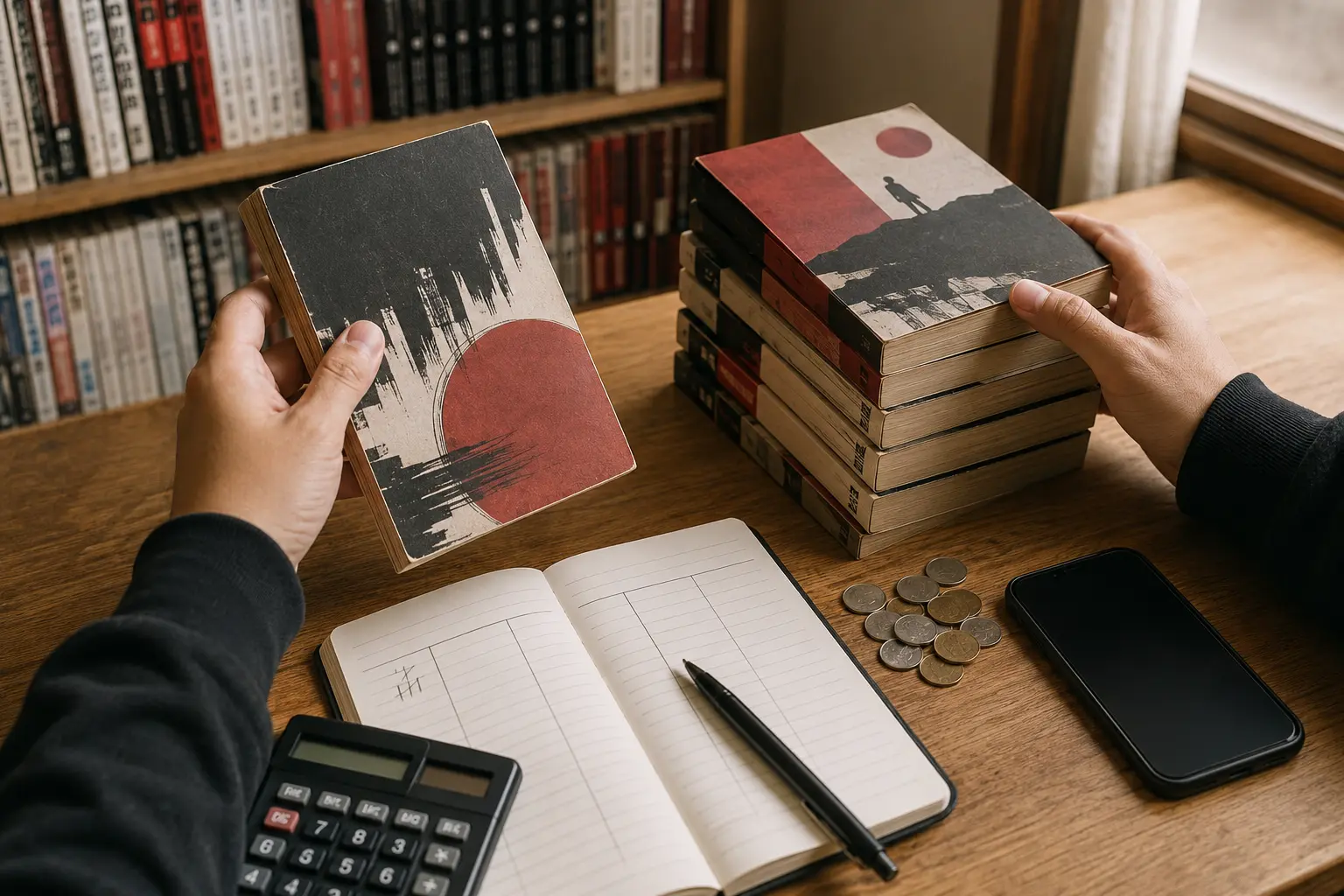
The fastest way to make manga collecting miserable is to treat every release, discount and “last copy” warning like an emergency.
One new series becomes six. A box set appears on sale. Somebody posts a shelf full of deluxe editions. Then a seller claims the volume missing from your run is out of print, and suddenly paying three times its normal price feels responsible.
That is fear of missing out, usually shortened to FOMO. It works because manga collecting combines stories we care about with numbered objects, matching spines and uncertain future availability. There is always another gap to fill.
A budget does not remove the fun. A good one removes the panic. It gives you permission to buy the manga you value while making it easier to leave the rest behind.
The short version: choose a monthly amount after essentials and savings, reserve money for the series you already follow, set price limits before shopping, calculate the real cost per book you want and never treat an unverified scarcity claim as a deadline.
There is no correct monthly manga budget
Collectors often ask how much other people spend each month. The answers are interesting, but they are not a target.
Someone with low housing costs and no dependants can spend more safely than a collector with the same income and larger commitments. One month may contain several planned releases; another may contain none. A budget of US$40 that fits comfortably is better than US$200 copied from somebody else's haul post.
Start outside the hobby. Australia's Moneysmart budgeting guidance recommends listing income and essential expenses first, including housing, food, utilities, transport, medical costs, insurance and debt repayments. Manga belongs in the money left for wants, not in rent money, emergency savings or borrowed money.
Choose an amount you can spend without needing next month's income to rescue this month. If the answer is zero for a while, that is still a valid budget. Reading what you already own costs nothing and usually makes the next purchase more deliberate.
All dollar examples in this guide are in US dollars and are illustrative planning amounts, not current retail prices.
Build a budget around priorities, not percentages
A rigid formula such as “spend half on new releases and half on older volumes” sounds tidy until your release schedule changes. It is more useful to give purchases different lanes.
Collector rule: if one lane uses the whole month's budget, the others wait. They do not become debt.
Here is how that might work with an illustrative US$100 monthly budget:
- Reserve US$50 for confirmed releases from series you actively collect.
- Allow US$30 for one chosen gap or planned older volume.
- Keep US$20 as a buffer for delivery, a genuine bargain or next month.
Those numbers are not a recommendation. The useful part is the order. Active commitments are visible before new temptations enter the picture. If nothing worth buying appears, the unspent money stays yours. A budget is a ceiling, not a challenge to reach zero.
Work out your real price per volume
The number on the product page is rarely the whole cost. Use the landed cost:
Book price + delivery + tax or import charges − genuine cashback or discounts = landed cost
Then divide the landed cost by the number of books you actually want.
That last word matters. Imagine a ten-volume used lot costs US$70 delivered, but you only want four books and expect the other six to sit unread. Your meaningful price is US$17.50 for each wanted volume, not US$7 for each object in the box.
This is how cheap hauls become expensive. The total looks efficient because there are many books, yet most of the money went towards titles you would never have selected individually.
Use different price limits for different formats. A standard paperback, three-in-one omnibus and oversized hardcover are not equivalent purchases. Decide the highest landed price you are comfortable paying for each format before opening an auction or sale page. Once bidding begins, your limit should not move simply because another person wants the same book.
Prioritise the series you are already reading
The most common early collecting mistake is buying volume 1 of everything. It creates a broad shelf, but also dozens of new commitments.
A better system is to divide series into three groups:
- Active: You are reading it, enjoying it and intend to continue.
- Waiting: You like it, but already own unread volumes or want to pause.
- Curious: You have not read enough to commit to a full physical run.
Fund active series first. Buy from the waiting group when you have caught up or when a planned opportunity appears. For curious series, sample one volume, borrow it, use a library or try an official digital release before buying a long run.
This is not about completing every active series immediately. It is about knowing which promises you have already made to your future budget.
Official publisher calendars, such as the VIZ release calendar and Yen Press release calendar, help make those commitments visible. Release dates can move, so check again before placing a preorder.
Make the Wishlist earn its name
A Wishlist should not be every book you have ever noticed. It should be the shortlist allowed to compete for your money.
Keep next releases, important gaps, planned samples and expensive books you are waiting to find below a set price. If you cannot explain why a book is on the list, remove it. You can always add it again.
Before a sale, review the Wishlist and choose the volumes that matter most. This turns the sale into a price check on planned purchases rather than a catalogue telling you what to want.
A sale only saves money when it changes the price, not the plan
Retailers are very good at turning percentages, countdowns and free-shipping thresholds into urgency. The simplest defence is a sentence worth remembering:
A discount does not turn an unwanted book into a bargain.
If a volume was not on your list before the sale, pause. Would you buy it next week at the same discounted price without the red banner? Would you buy it individually, or is it attractive only because it helps unlock free delivery?
Compare the final delivered total across retailers. A larger headline discount can disappear once postage is added. Cashback is only a saving if it is usable and does not encourage another unnecessary order. Do not add filler to “save” on shipping. Spending US$25 on an unwanted book to avoid US$10 delivery has cost US$15 more, not saved US$10.

Use a cooling-off rule for unplanned purchases
For anything not already scheduled, wait at least one night. For an expensive set or deluxe edition, wait several days.
Put it on the Wishlist, close the shop and return after the initial excitement has faded. During the pause, check:
- Whether you already own the same content in another edition
- Whether you have unread books from the same series
- The ordinary sold price, not just the seller's claimed saving
- Delivery and import costs
- Whether the edition is still supported by the publisher
- What planned purchase you would delay to afford it
A genuine want usually survives a short wait. An impulse often turns back into an ordinary book.
At conventions and second-hand shops, a specific copy may not return. The same test still applies. Your price limit decides which risk you accept.
Stop treating every unavailable volume as out of print
Out of stock is not the same as out of print.
An out-of-stock book is unavailable from a particular seller or distributor at that moment. More stock or another printing may arrive. An out-of-print book is no longer being produced in that edition, although publishers can still release a reprint, revised edition or new format later.
Marketplace prices do not prove either status. A listing titled “RARE OOP” proves only that the seller typed those words.
Before paying a scarcity premium:
- Check the publisher's current catalogue and release information.
- Search several established retailers, not only one marketplace.
- Look for recent publisher statements or contact customer service.
- Confirm the exact ISBN and edition.
- Check completed sales rather than ambitious active listings.
- Decide your personal maximum even if the book really is out of print.
Reprints are never guaranteed, but permanent scarcity is not guaranteed either. Yen Press has publicly documented bringing older titles back in new releases in its history of rereleases. Paying heavily for urgency becomes painful when a better new edition is announced later.
The collector community has been warning about this problem for years. In one discussion about budget and FOMO, collectors repeatedly point out that future out-of-print status is difficult to predict. That uncertainty is exactly why speculation should not control your current spending.
Set an out-of-print premium before you find the book
Sometimes a genuinely scarce volume is worth more to you. It may complete a favourite series, replace a damaged copy or be unlikely to receive another English edition.
Set the premium while you are calm. You might refuse to spend more than one month's whole manga budget on a single gap. The exact rule is personal.
Then ask what the premium achieves. If one book allows you to finish and read a beloved series, the value may be real. If it completes a row you no longer care about, the purchase is serving the shelf rather than you.
Do not buy scarce manga as an assumed investment. Reprints, licence changes, condition and demand can alter resale value. Buy it because owning that book at that price is worthwhile to you even if nobody later pays more.
Beware of the completion trap
Numbered spines make an incomplete run feel like a problem demanding a solution. It is not. It is a record of what you currently own.
Money already spent on volumes 1 to 8 does not make an unreasonable price for volume 9 sensible. You can wait, read digitally, borrow the missing book, mix editions, sell the incomplete run or simply keep it unfinished.
The same applies to series you stop enjoying. You do not owe the publisher or your shelf a complete set. A smaller collection full of books you like is better than a complete collection full of obligations.
Social media is a showroom, not a schedule
Large haul photos compress years of collecting into one image. You cannot see the person's income, what they sold, how long they saved or how much remains unread. Use other collections for ideas, not pace. If haul videos trigger unplanned orders, mute them and remove retailer alerts that manufacture urgency. Connecting buying with reading can also help: finish a few owned books before starting another physical series.
Use TankoVault as a filter, not another source of pressure
TankoVault can show released gaps and upcoming English volumes, but a missing book is information, not an instruction to buy.
Keep the exact volumes you genuinely intend to purchase on your Wishlist. Personal Release tracking helps you see what is coming for series you already collect, so those costs can enter the budget before a retailer email arrives. Exact-edition records also reduce the chance of spending money on a duplicate or the wrong format.
Recording purchase prices and acquisition dates gives you a view of what you actually spend rather than what you think you spend. If you import an existing spreadsheet through the collection importer, condition, purchase price and currency can remain attached to the matched collection records.
Collection Completion is most useful as a queue. Choose one or two gaps to work on and leave the rest visible without treating them as overdue tasks.
A simple monthly routine
You can run the whole system in fifteen minutes:
- Check next month's releases for active series.
- Reserve enough budget for the volumes you genuinely plan to buy.
- Choose one older gap or Wishlist priority.
- Set price limits including delivery.
- Leave a buffer instead of assigning every dollar.
- Record purchases as they arrive.
- At month-end, compare the plan with what you actually bought.
If you overspend, work out what triggered it and adjust the next plan. Maybe postage was higher than expected or sale alerts should be switched off.
The goal is not perfect financial discipline. It is a collection that grows at a pace your money, space and reading time can support.
Frequently asked questions
How much should I spend on manga each month?
Set it after essential expenses, debt repayments and savings. Choose an amount you can spend without borrowing or creating stress. Some months, that will be zero.
Are manga box sets always cheaper?
No. Divide the delivered price by the volumes you actually want, then compare it with buying them separately. Extras only have value if they matter to you.
Should I buy manga whenever it is on sale?
Buy planned books when the delivered sale price is genuinely good. An unplanned book is still unplanned at 40% off.
Is it worth paying more for out-of-print manga?
Sometimes, but verify that the exact edition is genuinely unavailable and set a maximum before negotiating. Pay for the value it has to you, not because a seller predicts future prices.
Is it okay to leave a series incomplete?
Absolutely. A gap is not debt. Wait for a fair price, use another format or stop collecting a series that no longer earns your money or shelf space.
The best collection is not the biggest one
Manga collecting on a budget is not about finding the maximum number of books per dollar. It is about making sure the money produces a collection you still value after the sale ends.
Prioritise the stories you read. Let ordinary stock return. Allow unplanned books to survive a cooling-off period. Keep price limits stronger than auction adrenaline, and remember that missing a deal is cheaper than buying a regret.
FOMO asks, “What if I never get another chance?” A budget asks the better question: What do I want this collection to become?