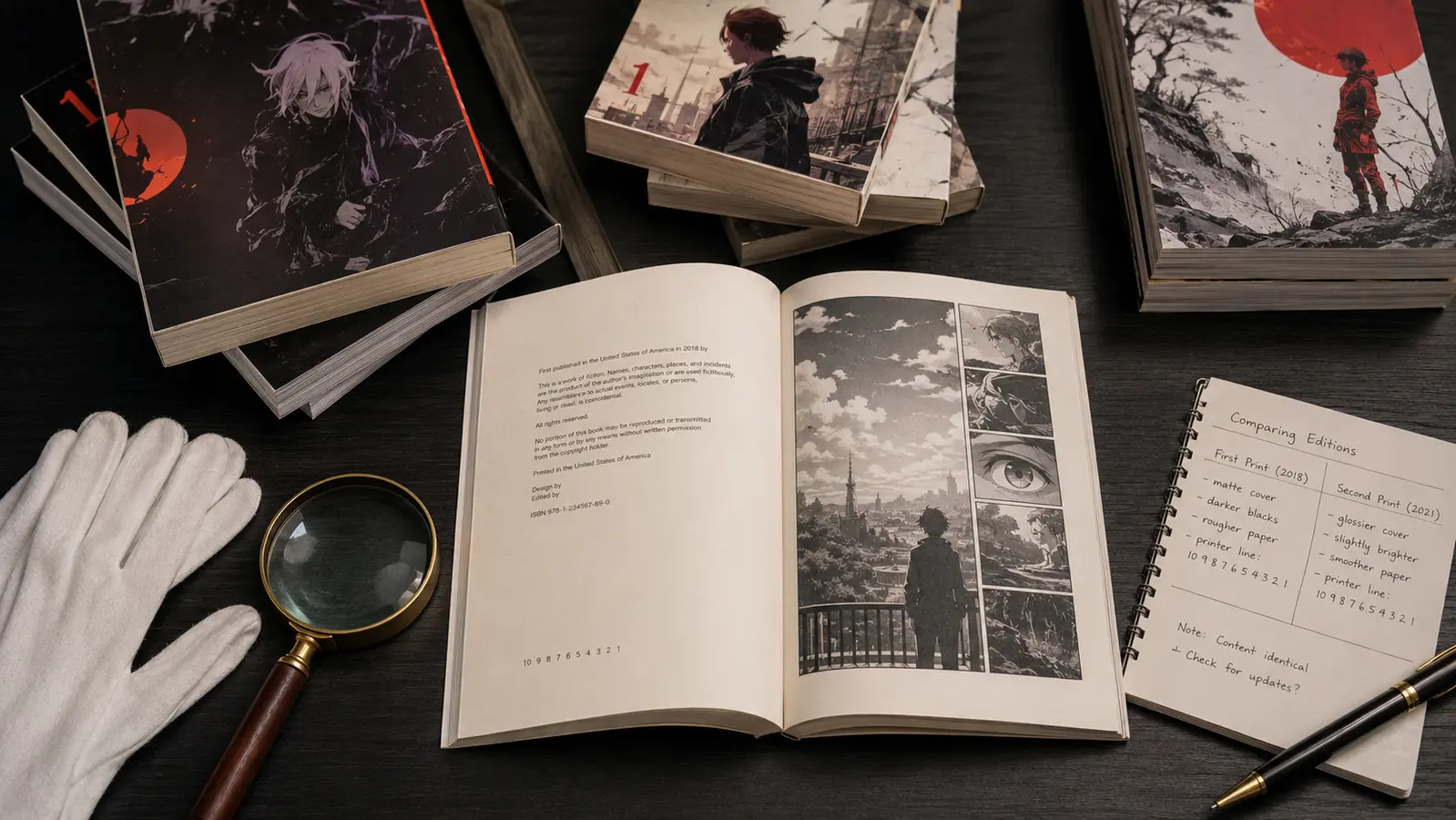
A seller lists an ordinary paperback as “FIRST PRINT, RARE” and asks three times the price of a new copy. The photos show the same cover, the same ISBN and, as far as anyone can tell, the same book.
Is the first printing actually worth more?
Sometimes. Usually, not for the reason the seller hopes.
Manga collecting has borrowed some language from rare books, comics and trading cards, but the rules do not transfer neatly. A first printing can be interesting, genuinely different or difficult to replace. It can also be a completely ordinary mass-produced copy whose only special feature is a tiny number 1 on the copyright page.
The useful question is not simply whether a volume is a first printing. It is what is different, how scarce that difference is and whether collectors actually care about it.
The short version: an edition is a particular version of a book, while a printing is one production run of that edition. Most later printings are not meaningfully different. Pay a premium only when you can identify a real difference, genuine scarcity and enough demand to support the price.
Edition and printing are not the same thing
These words are often used as if they mean the same thing. They do not.
An edition is a particular published version of a book. A new edition may change the translation, page size, binding, bonus material, cover design or the way several original volumes are collected. A paperback single and a hardcover deluxe release are different editions even when they contain the same chapters.
A printing, sometimes called an impression, is a production run within an edition. If the first batch sells through and the publisher orders more copies from the printer without making a substantial change, that is normally another printing of the same edition.
Penguin Random House defines a reprint as additional inventory produced after a title goes out of stock. Its publishing glossary also explains that an ISBN identifies a particular format and edition. That distinction matters because a later printing will often keep the same ISBN as the first printing. The barcode alone may tell you which paperback edition you have, but not when that individual copy was printed.
Think of it this way:
- Edition: Which version of the book is this?
- Printing: Which production batch of that version is this?
- Copy: The individual book sitting in your hands.
A listing that says “first edition” may merely mean the seller found the original copyright year. It does not automatically prove that the copy came from the first printing.
How to find the printing number in a manga volume
Open the book to the copyright page, usually near the front or back. English manga often places publication details there: the English publisher, copyright holders, translation credits, ISBN, original publication information and sometimes a printer's key.
A common printer's key looks like this:
10 9 8 7 6 5 4 3 2 1
Under the most common system, the lowest number still present indicates the printing. A line ending in 1 indicates the first printing. If the publisher reprints the same edition, it may remove the 1 so the lowest number becomes 2.
Collector rule: this is the common pattern, not a universal one. Read the complete copyright-page statement because publishers can arrange number lines differently.
The line does not always run backwards. Some publishers use ascending numbers, split odd and even numbers, include a year code or print a direct statement such as “First printing” or “First edition.” Yale's Beinecke Rare Book Cataloging Manual shows several valid patterns, including lines where the lowest number appears in the middle rather than at either end.
That is why “look for a 1” is useful but incomplete advice. Look at the whole statement, and remember that publisher practices vary. Older books may not use a number line at all.
What the copyright year does not tell you
The original copyright year can remain unchanged through many later printings. A manga first published in English in 2012 can still show 2012 prominently inside a copy printed years later.
Likewise, “First published in Japan” refers to the original work, not the production run of your English volume. A row of dates may record Japanese publication, English publication and later revisions without identifying the printing by itself.
If there is no clear printer's key or printing statement, do not invent certainty. Compare the copy with reliable photographs, publisher notices or collector documentation for that exact ISBN.
An ISBN identifies the edition, not every printing
The International ISBN Agency describes an ISBN as an identifier for a publication, publisher and format. A hardcover, paperback and ebook normally receive different ISBNs. A substantially revised version may also require a new one.
A straightforward reprint of the same paperback will often retain its ISBN. That means two copies with the same barcode can still have different printer's keys, paper stock, logo placement or corrected pages.
When buying, use the ISBN as the first filter, not the final answer:
- Match the ISBN to the publisher and physical format.
- Check the copyright page for a printing statement or number line.
- Compare known visual differences such as cover price, spine logo or included extras.
- Ask for photographs of the actual copy rather than a stock image.
This is particularly important when a series has changed publisher, moved between imprints or received a revised translation while keeping a very similar title.
When a first printing genuinely is different
Most first printings are ordinary books. The interesting cases are the exceptions.
First-print-only bonus material
Sometimes a publisher explicitly includes something only in the first run: colour pages, a poster, a card, stickers, a special cover treatment or another insert.
Square Enix's official listing for Ragna Crimson, Volume 2, for example, says its full-colour opening spreads were exclusive to the first printing. That is a real, documented content difference. Whether it deserves a premium still depends on condition, availability and how much buyers value those pages, but at least the claim has evidence behind it.
For loose extras, completeness matters. A first-print book advertised for its insert is not the complete first-print package if the insert has been removed.
Corrected errors
First does not always mean best.
The earliest batch is the one most likely to preserve an error that later printings fix. The mistake might be a typo, missing dialogue, duplicated page, incorrect image, binding fault or production issue.
Seven Seas documents several useful manga examples. The first printing of The Count of Monte Cristo manga had missing text on page 182, with the publisher stating that the second printing would correct it. The first printing of Magical Girl Spec-Ops Asuka, Volume 2 omitted a colour page; corrected printings also changed a cover logo from pink to green.
Those differences can pull value in opposite directions. A completist may want the identifiable error state. A reader may quite reasonably prefer the corrected copy. “First printing” is therefore a description, not a quality grade.
Revised translations or content
Some changes are substantial enough to be labelled a revised edition rather than a routine reprint.
Seven Seas revised the English script of I Think I Turned My Childhood Friend Into a Girl, Volume 1 after concerns about the original translation. The publisher says revised paperbacks identify “Revised Edition: February 2023” on the copyright page.
In a case like this, asking only for the printing number misses the information that matters. The buyer needs to know which text is inside the book.
Covers, logos and publisher changes
Spine and cover logos can change when a publisher refreshes its branding, moves a title to another imprint or changes distribution. Some collectors want a shelf with matching logos. Others like preserving the earliest design.
A logo variation can help identify a printing, but it is not universal proof. The same logo can span several printings, and old stock can remain in shops after a new design appears. Treat it as one clue alongside the copyright page and ISBN.
If a licence moves to a different English publisher, the result is normally more than a later printing. Translation, trim size, paper, lettering, cover treatment and included material can all change. Compare it as a different edition.
Paper and manufacturing changes
Collectors sometimes notice darker ink, thinner paper, different cream tones, stiffer covers or a new country of manufacture between copies with the same ISBN.
These changes can be real without being formally marketed. Printers, paper supply and production locations change. Small variation can also exist within one run, so a different shade of paper does not prove a separate printing on its own.
Manufacturing differences matter when they noticeably affect reading, durability or shelf consistency. They do not automatically create financial value.
What actually makes one printing worth more?
Value is produced by several things working together. The words “first printing” are only one possible detail.
A meaningful difference
There needs to be something buyers can identify and want: exclusive pages, an original logo, an uncensored panel, a corrected or uncorrected state, a special insert, a distinctive cover or historical importance.
Scarcity
The desirable version must be harder to find than the alternative. A first printing of a huge release can remain common for years. A later printing made in a small quantity can be scarcer.
Demand
Scarcity without demand is just obscurity. A variation becomes valuable only when enough collectors are actively looking for it.
Condition and completeness
Bent covers, mould, smoke odour, writing, sun fading and missing inserts can erase much of a supposed premium. For a fragile older release, a clean later printing may be the more desirable copy.
Evidence from completed sales
Active listings show what sellers hope to receive. Completed sales show what buyers have actually paid. Compare the same edition, printing, condition and completeness. One ambitious listing does not establish a market price.
Why sellers exaggerate first printings
“First printing” sounds precise, collectible and scarce. It can turn an otherwise ordinary listing into a story.
Sometimes the seller is accurately describing the book. Sometimes they assume manga works like key-issue comics. Sometimes they are repeating another listing. And sometimes the phrase is simply there to justify a higher price.
Be cautious when a listing:
- Shows no photograph of the copyright page
- Uses “first edition” and “first printing” interchangeably
- Claims rarity while new copies of the same ISBN remain widely available
- Describes a normal first print as an investment
- Prices from other active listings instead of sold results
- Cannot explain what differs from later copies
- Uses a stock cover while promising a particular logo or insert
Ask one calm question: What is different about this printing?
If the answer is only “it has a 1 inside,” you have learned something about the production run, not its market value.
Should you deliberately collect manga first printings?
Yes, if that is the version of the hobby you enjoy.
Some collectors like tracing how a series changed over time. A full run with matching early logos can be satisfying. Error states and corrected states can make an interesting pair. A first printing bought when a favourite series was new may also have personal value that no later copy can replace.
Just separate preference from investment language. You do not need a financial justification to enjoy a variation, and a variation does not need to rise in price to be worth owning.
For most readers, the better copy is the one with the content they want, in good condition, at a sensible price. A later printing may have corrected text, better production or simply fewer years of wear.
How to check a first-print listing before buying
Use this quick checklist:
- Confirm the exact English publisher, format and ISBN.
- Request a clear photograph of the full copyright page.
- Read the complete printer's key, not just the seller's description.
- Check whether the publisher documents any first-print bonus or correction.
- Confirm that inserts, posters, dust jackets and other extras are present.
- Compare the cover, spine logo, price and page count with known copies.
- Check condition closely, including page edges and odour.
- Compare completed sales for the same variation.
- Decide what the difference is worth to you before negotiating.
Our used manga buying guide covers the condition and listing checks in more detail.
Recording print variations in TankoVault
TankoVault's catalogue identifies the exact English volume through details such as publisher, format, edition and ISBN. That prevents a deluxe hardcover, omnibus and paperback single from being treated as the same physical book.
Printing variations can be more granular because the same catalogue volume may have several production runs under one ISBN. Add the exact volume to your Vault, then use your collection details and notes to record the variation that matters to you, such as “first printing,” “green corrected logo,” “includes colour insert” or “revised February 2023 text.”
If you own more than one state, record the condition and distinguishing feature for each copy. A short, specific note is more useful than labelling everything “rare.” It tells you why you kept that copy and what to verify if you later sell or replace it.
Frequently asked questions
Does a number 1 always mean first printing?
Usually in a conventional printer's key, but not always by itself. Read the complete number line and any accompanying edition statement. Publishers use different patterns, and some books do not include a printer's key.
Can two printings have the same ISBN?
Yes. Routine printings of the same edition and format commonly share an ISBN. A substantially changed edition or different format may receive a new ISBN.
Is a first printing automatically rarer?
No. A popular manga can have a very large first run, while a later reprint may be smaller. Availability and demand must be checked rather than assumed.
Are printing errors valuable?
Occasionally, when the error is identifiable, scarce and sought after. Many errors simply make the book less pleasant to read. A mistake does not create value by itself.
Do matching spine logos matter?
They matter to collectors who value a consistent shelf, but they do not change the story. Confirm which printings carry each logo before paying more, because cover clues are not always definitive.
The collector's rule that saves the most money
Do not pay for a label. Pay for a difference you can see, describe and value.
A first printing can be a fascinating piece of publishing history. It can preserve an exclusive bonus, an early design or a mistake that disappeared from every later copy. But most manga first printings are simply the first batch of a book produced for ordinary readers.
Open the copyright page. Verify the claim. Check what changed. Then decide whether that change matters to your collection.
Sources and further reading
- Yale Beinecke Rare Book Cataloging Manual: Number lines in modern trade publications
- Penguin Random House: Publishing glossary
- International ISBN Agency: What is an ISBN?
- Seven Seas: Magical Girl Spec-Ops Asuka, Volume 2 correction
- Seven Seas: The Count of Monte Cristo manga correction
- Seven Seas: I Think I Turned My Childhood Friend Into a Girl, Volume 1 revision
- Square Enix Manga & Books: Ragna Crimson, Volume 2
- MangaCollectors: Why do collectors not care much about first prints?